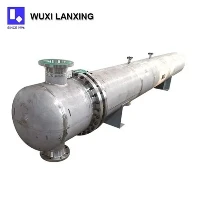
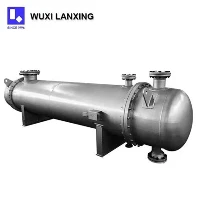
Hey there! As a supplier of Tube Bundle Heat Exchangers, I often get asked about the differences between single - pass and multi - pass tube bundle heat exchangers. So, I thought I'd write this blog to break it down for you in a simple and easy - to - understand way.
Let's start with the basics. A tube bundle heat exchanger is a device that transfers heat between two or more fluids. It consists of a shell (a large outer container) and a bundle of tubes inside it. The fluids flow either through the tubes or around the tubes in the shell, and heat is transferred from the hot fluid to the cold fluid.
Single - Pass Tube Bundle Heat Exchangers
A single - pass tube bundle heat exchanger is, as the name suggests, a heat exchanger where the fluid flowing through the tubes makes only one pass through the shell. This setup is relatively straightforward.
One of the big advantages of single - pass heat exchangers is their simplicity. They're easier to design, build, and maintain. There are fewer components and fewer potential points of failure. This means less hassle for you as a user. If something goes wrong, it's usually easier to diagnose and fix.
Another plus is that single - pass heat exchangers often have lower pressure drops. Since the fluid doesn't have to make multiple turns or navigate through complex internal structures, it can flow more smoothly. This can be a big deal in applications where maintaining a certain pressure level is crucial.
However, single - pass heat exchangers do have their limitations. The heat transfer efficiency is generally lower compared to multi - pass ones. Because the fluid only passes through the shell once, the temperature difference between the hot and cold fluids decreases over the length of the tubes. This reduces the driving force for heat transfer. So, if you need to transfer a large amount of heat in a small space, a single - pass heat exchanger might not be the best choice.
For example, in some simple water - heating applications where the temperature difference between the hot and cold water is large and the required heat transfer rate is not extremely high, a single - pass heat exchanger can work just fine. But if you're dealing with more demanding processes, like in a chemical plant where precise temperature control and high - volume heat transfer are needed, a single - pass heat exchanger might fall short.
Multi - Pass Tube Bundle Heat Exchangers
Multi - pass tube bundle heat exchangers allow the fluid in the tubes to make multiple passes through the shell. This is usually achieved by using baffles or partitions inside the shell to guide the fluid flow.


The main advantage of multi - pass heat exchangers is their high heat transfer efficiency. By making multiple passes, the fluid has more opportunities to exchange heat with the fluid in the shell. The baffles also help to create a more turbulent flow, which enhances the heat transfer coefficient. This means that for the same size and operating conditions, a multi - pass heat exchanger can transfer more heat than a single - pass one.
In addition, multi - pass heat exchangers are more flexible when it comes to achieving different temperature profiles and heat transfer rates. You can adjust the number of passes and the design of the baffles to suit your specific needs. This makes them a great option for a wide range of applications, from industrial processes to HVAC systems.
But multi - pass heat exchangers come with their own set of challenges. They're more complex to design and fabricate. The baffles and internal partitions add to the manufacturing cost and also increase the chances of fouling. Fouling occurs when deposits build up on the tubes or baffles, which can reduce the heat transfer efficiency and increase the pressure drop. Maintenance also becomes more complicated as accessing and cleaning the internal components can be more difficult.
Applications
Let's talk about the applications of these two types of heat exchangers.
Single - pass heat exchangers are commonly used in applications where simplicity and low cost are the main priorities. For example, in small - scale residential or commercial heating systems, a single - pass heat exchanger can be used to heat water using a hot fluid like steam or hot water from a boiler. They're also found in some industrial processes where the heat transfer requirements are not very demanding, such as in pre - heating applications.
On the other hand, multi - pass heat exchangers are widely used in industrial settings. In chemical plants, they're used to cool or heat reactants in various chemical processes. In power plants, multi - pass heat exchangers are used for condenser and feed - water heating applications. They're also commonly used in the oil and gas industry for oil cooling and gas processing.
If you're in the market for a heat exchanger, you might be interested in some of our products. We offer a wide range of heat exchangers, including Gas Cooling Heat Exchanger, Alloy Steel Tubular Heat Exchanger, Heat Pump Plate Heat Exchanger, Oil Cooler For Car, and Steel Shell and Tube Heat Exchanger. Whether you need a single - pass or multi - pass heat exchanger, we've got you covered.
Conclusion
In conclusion, the choice between a single - pass and multi - pass tube bundle heat exchanger depends on your specific requirements. If you need a simple, cost - effective solution with low pressure drops and your heat transfer needs are relatively modest, a single - pass heat exchanger might be the way to go. But if you require high heat transfer efficiency and flexibility in your process, a multi - pass heat exchanger is probably a better option.
If you have any questions about which type of heat exchanger is right for your application, or if you're interested in our products, don't hesitate to reach out. We're here to help you make the best choice and get the heat exchanger that meets your needs.