
Hey there! As a supplier of U Tube Heat Exchangers, I've been in the thick of heat exchanger design for ages. One of the super important things in this field is using fluid specific heat properly in the design of a U tube heat exchanger. So, let's dig into how we can do that.
First off, what's fluid specific heat anyway? Well, it's the amount of heat energy needed to raise the temperature of a given mass of a fluid by one degree. Different fluids have different specific heats, and this property plays a huge role in how heat exchangers work.
When you're designing a U tube heat exchanger, you've got to know the specific heat of the fluids you're dealing with. Why? Because it directly affects the amount of heat transfer that can happen. Let's say you've got a Tubular Heat Exchanger Tubular Heat Exchanger. The cold fluid goes through the tubes, and the hot fluid flows around them. The specific heat of the cold fluid will tell you how much heat it can absorb. If the specific heat is high, the fluid can soak up a lot of heat without a big increase in temperature. On the other hand, a fluid with a low specific heat will heat up quickly with a relatively small amount of heat input.
Let's take an example of an Oil Cooling Heat Exchanger Oil Cooling Heat Exchanger. Oil usually has a lower specific heat compared to water. So, when you're designing this heat exchanger, you need to take this into account. You might need a larger flow rate of the cooling fluid (say water) to remove the heat from the oil effectively. The formula for heat transfer, (Q = m \times c_p \times \Delta T), is super handy here. (Q) is the heat transfer, (m) is the mass flow rate of the fluid, (c_p) is the specific heat of the fluid, and (\Delta T) is the temperature difference between the inlet and outlet of the fluid.
In a Shell And Tube Type Heat Exchanger Shell And Tube Type Heat Exchanger, the shell side and tube side fluids will have different specific heats. You've got to balance the flow rates and the design of the exchanger to make sure the heat transfer is as efficient as possible. If you've got a fluid with a high specific heat on one side, you might be able to get away with a lower flow rate as it can carry more heat per unit mass.
For a Gas Cooling Heat Exchanger Gas Cooling Heat Exchanger, gases typically have a lower specific heat than liquids. This means that you need to be extra careful with the design. You might need to increase the surface area of the heat exchanger tubes to enhance the heat transfer. Since the gas can't carry as much heat per unit mass as a liquid, more contact area is often necessary to transfer the required amount of heat.
Now, let's talk about a High Working Pressure Shell and Tube Heat Exchanger High Working Pressure Shell and Tube Heat Exchanger. The specific heat of the fluids still matters big time. Under high pressure, the properties of the fluids can change slightly, including their specific heat. You've got to use accurate data for the specific heat at the operating pressure and temperature. This ensures that the heat exchanger will perform as expected and won't have any unexpected issues due to incorrect heat transfer calculations.
When it comes to actually using the specific heat in the design process, you start by gathering data on the fluids. You need to know their specific heats at the operating temperatures and pressures. Then, you use the heat transfer formula to calculate the heat load. Once you've got the heat load, you can start sizing the heat exchanger. You'll determine the number of tubes, the tube diameter, the shell diameter, and the length of the exchanger based on the heat transfer requirements and the specific heats of the fluids.
It's also important to consider the flow distribution in the heat exchanger. Uneven flow can lead to inefficient heat transfer. You want to make sure that the fluids are flowing evenly across all the tubes and around the shell to maximize the contact area and the heat transfer. The specific heat affects how the fluids respond to the heat transfer, so it's all interconnected.
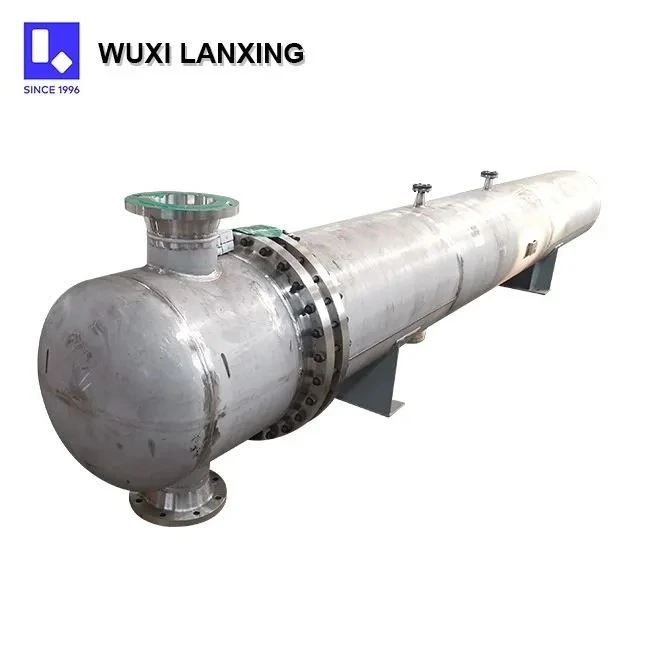

Another thing to keep in mind is the fouling factor. Over time, deposits can build up on the heat exchanger surfaces, reducing the heat transfer efficiency. The specific heat of the fluids can influence how quickly fouling occurs. For example, if a fluid has a high specific heat and a high viscosity, it might be more likely to cause fouling. You need to account for this in the design and choose appropriate materials and cleaning methods.
In conclusion, using fluid specific heat correctly is crucial in the design of a U tube heat exchanger. It affects everything from the heat transfer rate to the sizing and the long - term performance of the exchanger. Whether you're dealing with an oil cooling exchanger, a gas cooling exchanger, or any other type, understanding and applying the concept of specific heat is key to a successful design.
If you're in the market for a high - quality U tube heat exchanger, I'd love to talk to you. Our team of experts can help you design the perfect heat exchanger based on your specific fluid requirements and operating conditions. Whether it's figuring out the right specific heat values or optimizing the design for maximum efficiency, we've got you covered. So, don't hesitate to reach out for a chat and let's start working on your heat exchanger project together.


